


XVI SIMPOSIO: Regional Trade Associations Call for Prioritizing Legal Stability to Compete for Critical Metals Globally
- During the debate that brought together representatives from Argentina, Brazil, Chile, and Peru, Angela Grossheim (SNMPE) cautioned that excessive regulation and administrative obstacles reduce competitiveness in the face of the urgent need to attract capital for the energy transition.
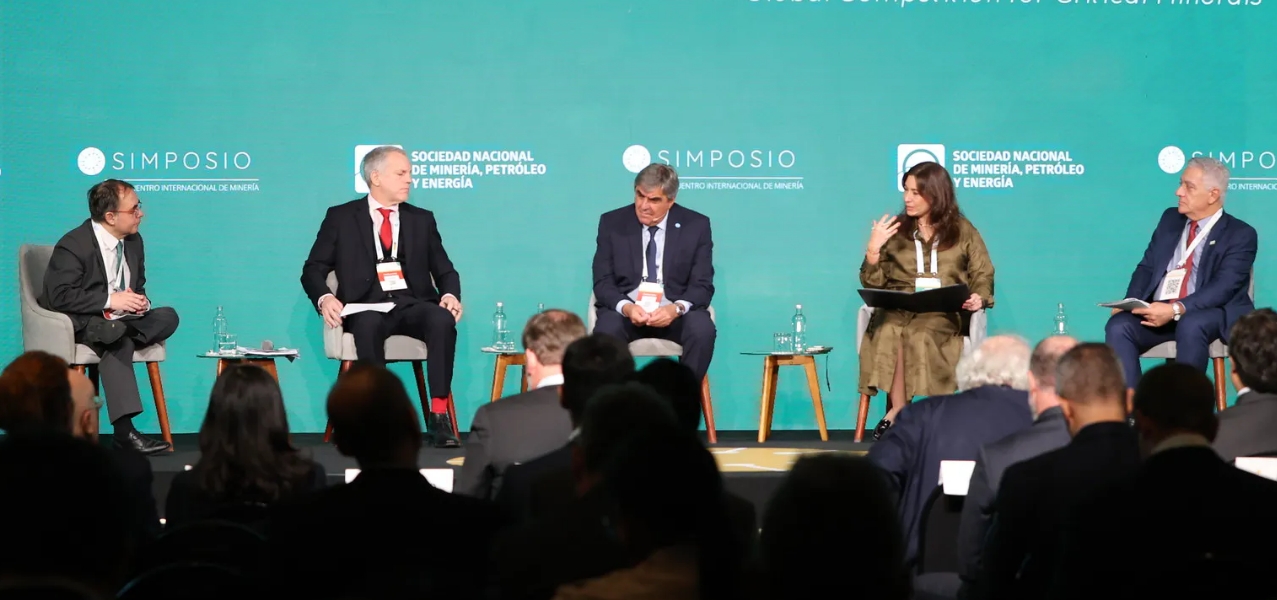
Lima, May 28, 2026. On the last day of the SIMPOSIO– XVI International Mining Meeting, an event organized by the National Society of Mining, Petroleum and Energy (SNMPE), a roundtable was held as part of the block “Latin America in the Context of Global Competition for Critical Minerals”, where the urgency of unifying regulatory criteria, accelerating the execution of projects, and consolidating regional legal security was emphasized.
Under the leadership of Juan Carlos Guajardo (Plusmining), industry representatives from Peru, Chile, Brazil, and Argentina agreed that South America faces a historic window of opportunity due to the energy and digital transitions. However, they cautioned that the continent’s mineral wealth does not guarantee success if internal institutional conditions discourage investment in the face of competition from other global players.
Angela Grossheim, the Executive Director of SNMPE, commenced the analysis by underscoring that Peru is home to 8 of the 17 critical minerals required worldwide. She noted the country’s investment portfolio comprises 65 projects valued at USD 63 billion, with copper representing 75% of this total. Grossheim emphasized Peru’s “strategic location as a bridge to Latin America,” bolstered by the port of Chancay and enhancements in Callao, alongside a robust openness to foreign investment facilitated by international trade agreements.
For his part, Carlos Urenda, general manager of the Consejo Minero (Mining Council) of Chile, agreed with Grossheim that state obstacles (overregulation, permits, among others) are also a critical factor in his country. “We do not have red tape, but we need permitting. It is a very complex system, with environmental laws, sector-specific permits, and court rulings that hinder projects”, Urenda stated, adding that labor rigidity and energy costs reduce competitiveness given the urgency of executing projects that are already ready.
For his part, Rinaldo Mancin, Director of Sustainability and Corporate Affairs at the Brazilian Institute of Mining (IBRAM), described the lack of coordination and the disconnect between the state and the sector as not unique to Peru or Chile, detailing the situation in Brazil. He contends that mining remains largely invisible in public policy discussions, despite the interest from the United States and Europe in financing lithium and rare earth projects.
Mancin questioned proposals for greater state control in his territory, among other challenges: “We have strong reserves and significant mineral potential. What do we lack in Brazil? We lack access to financing and technology. If we are to leverage a new sector, incentives must be established. The challenge is to maintain competitiveness while avoiding political conflicts”, he explained.
In contrast, Roberto Cacciola, the president of the Argentine Chamber of Mining Companies (CAEM), highlighted how his country is striving to differentiate itself through aggressive regulatory reforms, aimed at providing predictability for businesses. He detailed the advancements in lithium and the projections for copper in Argentina, attributing these improvements to recent measures designed to attract long-term capital. “The RIGI (Large Investment Incentive Regime) has provided investors with the certainty that they will be able to develop their investments without limitations, something crucial given the past non-compliance. The glacier law now strengthens the scope of protection but gives the provinces authority on the ground”, he explained.
Common goals
Faced with this common problem in the region, the speakers concurred on the most critical aspects of each country’s agenda and the current regulatory obstacles. They emphasized the need for clear leadership and a review of permitting processes—not to lower standards, but to assess how the various public entities coordinate with one another. In this context, they argued that mining projects should be considered a goal. For example, in Peru, there are currently 29 public entities involved and over 260 permits required to advance a single project.
Faced with these barriers and within the framework of the bloc’s geopolitical balance, the business leaders of Peru, Argentina, Chile, and Brazil emphasized the need to maintain a policy of total and transparent openness towards all international markets without ideological bias, focusing the eligibility requirements for capital strictly on compliance with high socio-environmental standards that guarantee the sustainability of operations.
Photos are available at the following link: https://flickr.com/photos/195630249@N08

