




XVI SIMPOSIO: Illegal Mining Is Not Only an Environmental or Economic Problem; It Is a Phenomenon That Violates Human Rights
- Illegal mining cannot be understood solely as an environmental or economic problem, but as a phenomenon of organized crime and citizen security that requires a comprehensive and systemic approach, as well as the coordinated participation of various actors from the public and private sectors.
Lima, May 28, 2026. Illegal mining cannot be understood solely as an environmental or economic problem, but as a phenomenon of organized crime and citizen security that requires a comprehensive and systemic approach, as well as the coordinated participation of various actors from the public and private sectors.
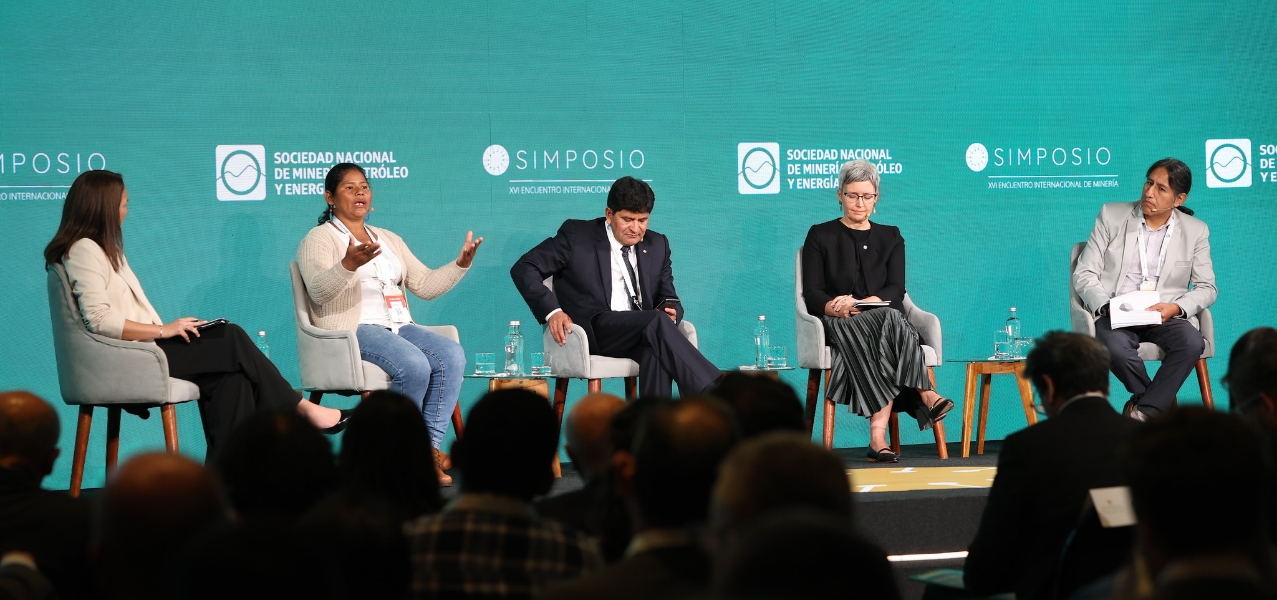
These ideas were presented at the panel on the impact of illegal economies on human rights, held during the SIMPOSIO– XVI International Mining Meeting, organized by the National Society of Mining, Petroleum and Energy (SNMPE). The panel was moderated by Jessica Vásquez, president of the SNMPE Human Rights Committee and Sustainability Manager at Minsur. The panel included Jane Anttila, head of the Technical Mission in Peru for the Office of the United Nations High Commissioner for Human Rights; Marcelina Angulo, Human Rights Advocate for the Management Committee of the Pintuyacu, Chambira, and Alto Nanay Regional Conservation Area; Paulo Vilca, a political scientist at the Instituto de Estudios Peruanos (Institute of Peruvian Studies); and Rohel Sánchez, regional governor of Arequipa.
Jane Anttila maintained that the formal mining sector plays a key role in addressing the challenges posed by illegal mining. “For us, the formal mining sector is an extremely important ally in confronting the human rights challenges presented by illegal mining”, she stated.
The representative of the Office of the United Nations High Commissioner for Human Rights indicated that violations in the context of illegal mining are not isolated incidents or collateral damage, but rather structural elements of its operation. Therefore, she emphasized that the State has the obligation to respect, protect, and guarantee human rights, even when it faces institutional limitations.
For his part, Paulo Vilca warned that illegal gold mining must be understood as part of a transnational economy. He argued that it is not enough to view the problem solely within Peruvian territory; rather, the entire chain must be examined, including buyers, refineries, distributors, banks, and international markets.
Looking ahead to the next government, he stated that two key decisions await: defining the conditions under which a new ASM Law will be approved and establishing a clear stance regarding the REINFO (Mining Formalization Registry). Vilca added that addressing illegal mining cannot be resolved solely through increased police, military personnel, or interdictions. “A strong political coalition is needed in this country to find an alternative solution to this problem”, he asserted.
Marcelina Angulo offered valuable testimony on the impact of illegal mining in Alto Nanay, Loreto. She pointed out that the introduction of this activity radically changed the lives of the communities, resulting in deforestation, water pollution, and adverse effects on the health of children, youth, and families.
“In the Amazon, we are forgotten by the State and by our regional and municipal governments”, she stated. Angulo warned that the lack of opportunities drives young people and women into illegal economies, where they face exploitation, threats, and violence.
Rohel Sánchez added that illegal economies have flourished in areas where the State does not maintain an effective presence or implement medium- and long-term public policies.
The regional governor warned that the regions face the direct consequences of the problem, yet many tools for control, formalization, prosecution, and intelligence are concentrated in the national government. He therefore called for a clear definition of responsibilities, along with adequate budget, personnel, and operational capacity, to ensure a guaranteed and effective state presence throughout the territory.
“When citizens feel that the authorities cannot protect them, they lose faith in institutions. That is why we, as part of the public and private sectors, must ensure transparency in our activities and actions. Only through this transparency can we build trust, foster consensus, and establish dialogues that enable us to prioritize the appropriate solutions”, Sánchez stated.
Finally, Jessica Vásquez highlighted that formal companies have made progress in due diligence and traceability, but that it is necessary to continue building a responsible mineral supply ecosystem, with absolute traceability from extraction to sale in international markets.
Photos are available at the following link: https://flickr.com/photos/195630249@N08

