


XVI SIMPOSIO: Peru Needs a Long-Term Strategy to Turn the Mining Boom into Sustainable Development
- During the SIMPOSIO – XVI International Mining Meeting, global economist Dambisa Moyo argued that Peru must strengthen its domestic market, build a narrative of inclusive growth, assume greater regional leadership to capitalize on the current favorable cycle in the minerals sector, and attract investment in a more competitive global environment.
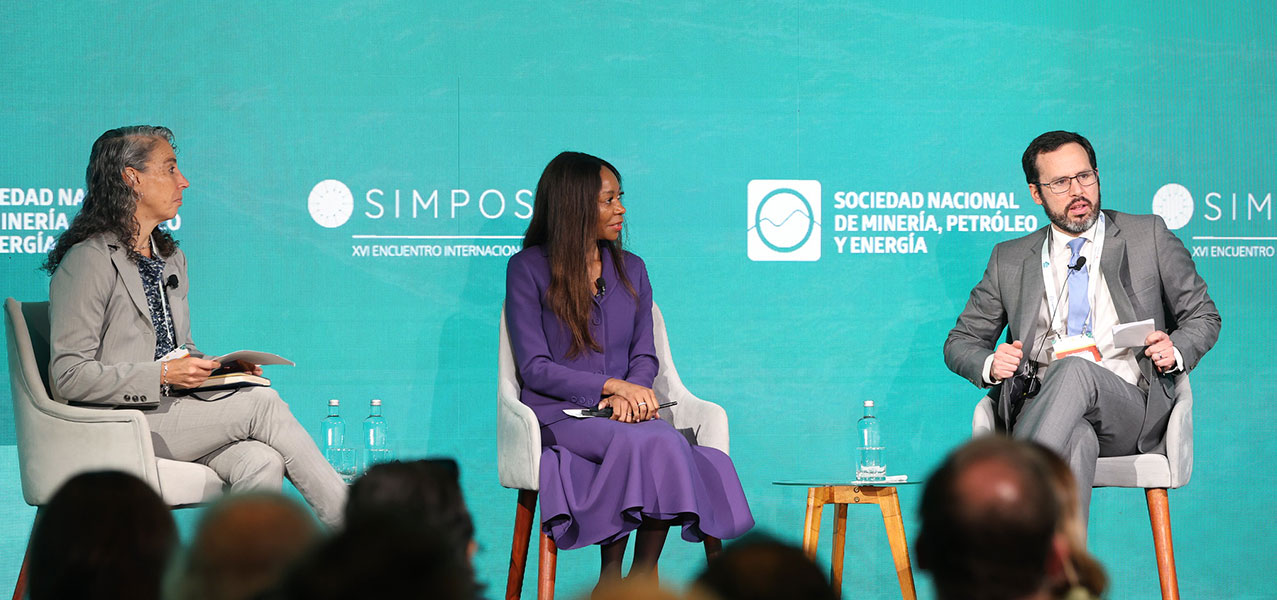
Lima, May 26, 2026. In a context marked by geopolitical fragmentation, capital shortages, and the energy transition, international economist Dambisa Moyo pointed out—in a conversation with Peruvian economists Carolina Trivelli, a member of the Fiscal Council of the Ministry of Economy and Finance, and Diego Macera, director of the Peruvian Institute of Economics (IPE)—that Peru needs to develop a long-term strategy to transform the current favorable cycle in the mining sector, the so-called boom, into sustainable development, greater competitiveness, and increased social stability.
During the panel “Conversation with the Keynote Speaker,” held as part of the SIMPOSIO – XVI International Mining Meeting, Moyo argued that the country must focus on strengthening its domestic market and projecting a broader and more inclusive vision of growth.
Leadership from Peru
The economist noted that, in a more competitive international environment, it is not enough to rely on natural resources or short-term economic growth. “In a world where capital is scarce, the story we tell (to attract investment)—the vision of what we want to achieve—has to be much more compelling,” she said.
The specialist in macroeconomics and globalization stated that Peru should seize the opportunity to exercise greater regional leadership and attract more investment. However, she emphasized that the volatility of public policies can negatively affect investor perception.
She also noted that to grow, the country must avoid relying exclusively on the current mineral supercycle and move toward structural transformations. In that vein, she pointed out that China’s growth and the global demand for commodities are not permanent, which is why she raised the need to define what Peru’s “manifesto” will be over the next five to ten years—that is, how the resources generated by mining will be used to drive progress.
Diego Macera added that developing countries should examine the experiences of economies that have successfully designed long-term development strategies by effectively managing their natural resources to drive economic growth. He also noted that, in the case of small or emerging economies such as Peru, a lack of political and institutional continuity in key areas can undermine the ability to implement sustained economic policies.
After noting that several countries continue to face structural problems of inequality, basic infrastructure, and social gaps, despite generating high revenues from their natural resources, Moyo stated that “the big question for mineral- and hydrocarbon-based economies is how to do better.”
The economist also emphasized that the private sector, particularly the mining sector, can play a broader role in the country’s economic and territorial development. She explained that the sector’s impact can be expanded to boost supply chains, services, universities, and other related productive activities.
Global and Local Context
On the other hand, Trivelli noted that the country is currently in an election cycle, with public sentiment running high. She emphasized that inflation will be a major issue throughout the year and that the country will also face pressures from rising international oil prices.
However, he noted that this scenario coexists with a favorable context of high revenues derived from the mineral supercycle, which will mean greater resources for the next government. In that regard, he cautioned that the challenge will be to properly manage this combination of opportunities and risks.
Finally, Dambisa Moyo stated that inequality and the lack of inclusive growth pose risks to the stability and continuity of economic growth. For this reason, she believed that mining has the opportunity to drive education, territorial development, and the closing of social gaps. “We have to ask ourselves what growth really means and what the strategy is for distributing the resources that generate that growth,” she said.
The SIMPOSIO – XVI International Mining Meeting, organized by the SNMPE, is taking place from May 26 to 28 at the JW Marriott Lima Hotel, under the theme “Mining that integrates, builds the present, transforms the future.”
Photos are available at the following link: https://flickr.com/photos/195630249@N08

