

XVI SIMPOSIO: Peru Has A “Once-In-A-Lifetime Opportunity” To Turn Its Critical Minerals into Development
- Diego Ortega, president of the SIMPOSIO – XVI International Mining Meeting, stated that global competition for copper and strategic minerals represents a structural transformation driven by the energy transition, artificial intelligence, and economic security, and no longer depends solely on economic cycles.
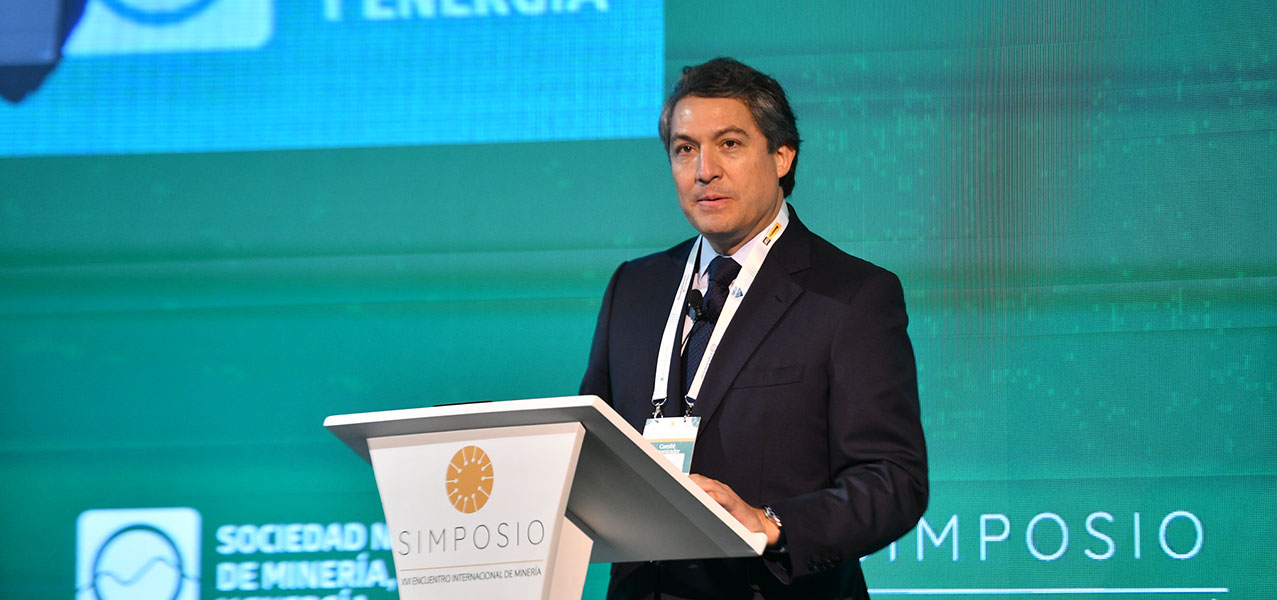
Lima, 26 de mayo de 2026. Diego Ortega, president of the SIMPOSIO – XVI International Mining Meeting, stated that Peru is facing a critical opportunity to establish itself as a strategic player in the new global landscape, which is characterized by growing demand for critical minerals. However, he also warned that the country’s main challenge remains transforming its geological potential into viable projects and sustainable development.
During his opening remarks at the event organized by the National Society of Mining, Oil, and Energy (SNMPE), Ortega noted that the current situation represents a structural transformation for the mining industry, rather than a temporary market cycle.
“What is happening today with copper and other critical minerals is not just another cycle. It is a global transformation,” he said. Ortega explained that demand for these resources is now driven by factors such as the energy transition, electrification, artificial intelligence, data centers, and energy security.
In that context, he stated that critical minerals are no longer merely commodities but have become strategic assets in the new global geopolitical order. He added that the reconfiguration of supply chains has placed Latin America in a central position.
Regarding Peru, he highlighted that the country holds nearly 12% of the world’s copper reserves, maintains an open economy, and is geopolitically aligned with the main consumer markets. However, he cautioned that the opportunity is not guaranteed. “Peru’s problem is not geological: the challenge is to turn that potential into viable projects,” he stated.
Ortega noted that the latest global survey by the Fraser Institute ranks Peru 41st among 68 mining jurisdictions evaluated, even though the country ranks among the world’s top nations for geological potential. As he explained, investors’ main concern is the country’s ability to develop projects within reasonable timeframes and under predictable institutional conditions.
He also emphasized that improving competitiveness does not mean lowering environmental or social standards. On the contrary, he argued that the mining industry of the future will be increasingly demanding in terms of sustainability, traceability, and social legitimacy. “Copper produced under high environmental and social standards will be more valuable, attract better investments, and gain access to more sophisticated markets,” he noted.
In this context, he pointed out that the XVI SIMPOSIO will address topics such as competitiveness, sustainability, energy security, mining exploration, technology, talent, and geopolitics. He also highlighted the participation of international experts such as Dambisa Moyo, an economist specializing in macroeconomics and globalization; and Diego Montoya, Google’s country manager for Peru and Ecuador, who will analyze the impact of artificial intelligence on productivity and the economy.
Finally, Ortega noted that the cost of inaction today is significantly higher than in previous decades. “It is no longer just a matter of missing out on a round of investments. It is a matter of missing a once-in-a-lifetime opportunity that will likely never recur under the same conditions,” he concluded.
Photos available at the following link: https://flickr.com/photos/195630249@N08

