


XVI SIMPOSIO: IFC Highlights the Role of ESG Standards in Enabling World-Class Projects
- The International Finance Corporation brought together specialists to discuss standards as a tool to reduce risks, strengthen confidence, facilitate access to capital, and improve the long-term viability of projects.
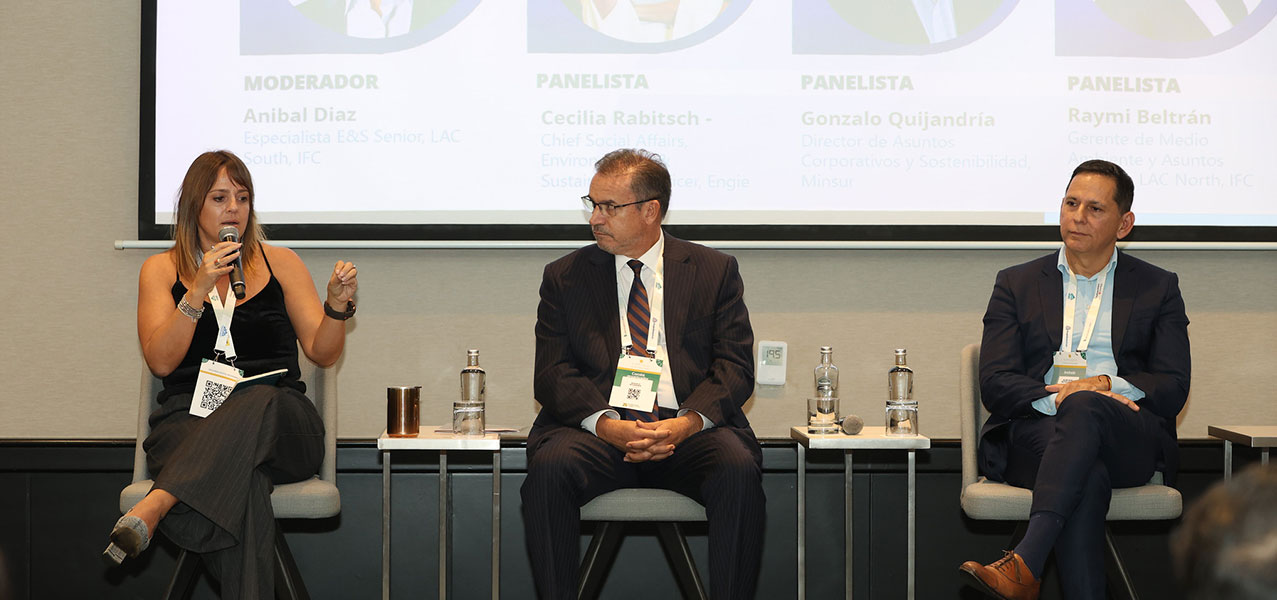
Lima, May 28, 2026 – Within the framework of the SIMPOSIO, XVI International Mining Meeting, the International Finance Corporation (IFC) held the session “Beyond Sustainability: ESG Standards for World-Class Projects,” a space that brought together representatives of the sector to analyze how environmental, social, and governance standards are a strategic tool for the development of mining and energy projects.
During the opening, Ivana Fernández Duarte, IFC’s general manager in Peru, emphasized that the performance standards have become a global benchmark for structuring projects, managing environmental and social risks, and building trust with investors, regulators, and communities. “Meeting these standards facilitates access to sustainable and responsible international capital,” she noted.
Shifting its focus to Peru, Fernández added that numerous projects are situated in socially and environmentally sensitive areas, making early engagement and authentic dialogue with communities essential for fostering trust. “At IFC, we are optimistic about the positive impact that adopting these standards will have on the mining and energy sectors, their workers, communities, and the Peruvian economy as a whole,” she stated.
From a technical standpoint, Raymi Beltrán, Environmental and Social Affairs Manager at IFC, LAC North, highlighted that the application of these standards significantly enhances project quality and viability. Drawing on his experience in Peru, he noted that incorporating the mitigation hierarchy from the design phase enables the avoidance of impacts, reduction of costs, and improvement of relationships with the surrounding environment. “Implementing the performance standard effectively prevents conflicts, safeguards environmental and social impacts, and fosters trust within communities,” he remarked.
Anibal Díaz, Senior E&S Specialist for LAC South, asserted that “for a project to achieve success, social feasibility must hold equal importance to technical feasibility. Beyond operational concerns, environmental and social considerations should be integrated from the design phase through to contractor management.”
Similarly, Cecilia Rabitsch, Vice President of Social, Environmental, and Sustainability Affairs at Engie Peru, noted that the adoption of these standards is both strategic and necessary. She added that they facilitate streamlined decision-making, cultivate trust in the region, and establish a common ethical and operational framework for project development. “Sustainability is not merely a theoretical concept; it is an operational criterion that informs decision-making from the perspectives of engineering, planning, and operations,” she stated.
Finally, Gonzalo Quijandría, president of the SNMPE Mining Sector Committee and vice president of Corporate Affairs and Sustainability at Minsur, stated that ESG standards offer a common language for developing world-class projects and accessing financing under global parameters. “For us, applying performance standards was important to demonstrate that we could manage a world-class project,” he indicated. He added that this process not only strengthened management systems and allowed access to more demanding markets but also generated a cultural shift within the organization. “That is what the standards gave us, and how, I would say, the story began,” he noted.
Throughout the session, participants agreed that ESG standards should no longer be understood solely as compliance requirements, but rather as tools that unlock capital, anticipate risks, strengthen social license to invest, and ensure the operational sustainability of projects. In a context of energy transition and growing demand for minerals and infrastructure, integrating these criteria from the outset not only improves environmental and social performance but also strengthens competitiveness and long-term business continuity.
Photos are available at the following link: https://flickr.com/photos/195630249@N08

