



Gold Traceability and Processing Plant Supervision: Key Strategies for Strengthening Responsible Mining in Artisanal and Small-Scale Mining (ASM)
- Within the framework of the XVI SIMPOSIO, the Embassy of Switzerland and Swiss Better Gold highlighted the importance of gold traceability to guarantee its formal origin and facilitate access to responsible international markets.
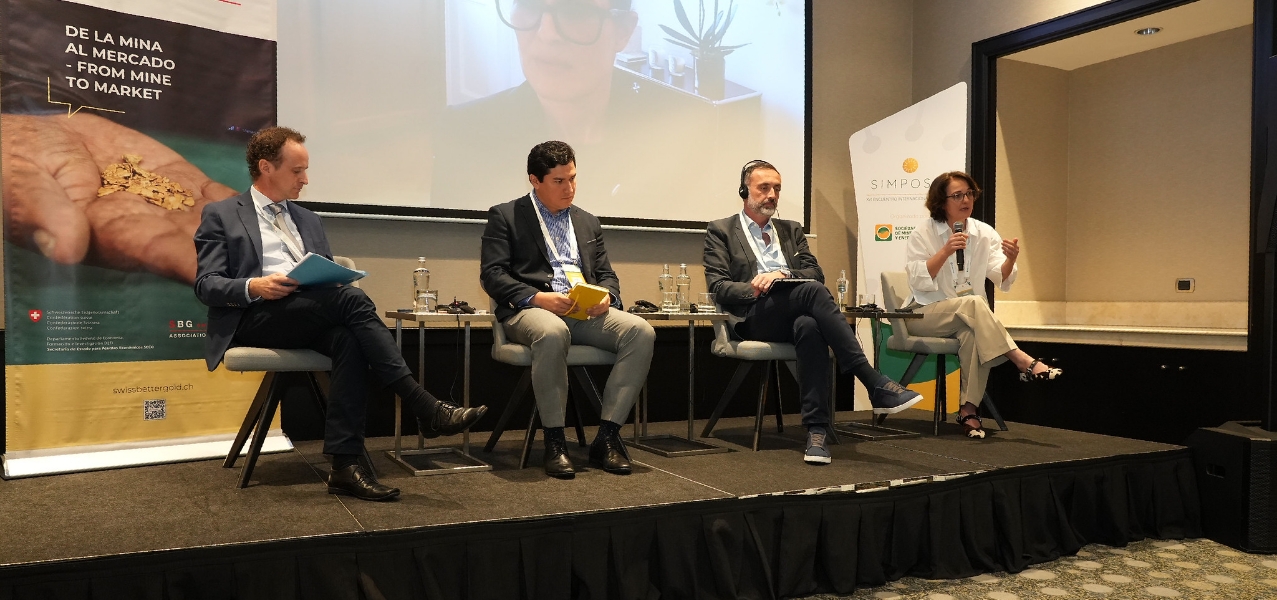
Lima, May 28, 2026. Within the framework of the SIMPOSIO – XVI International Mining Meeting, the Embassy of Switzerland and the Swiss Better Gold Association (SBGA) presented the “Swiss Better Gold Sourcing Strategy: The Role of Processing Plants in Gold ASGM”, focusing on the role of these processing centers to promote good practices, due diligence, and formalize the sector.
During the event, the Swiss Ambassador to Peru, Paul Garnier, emphasized that gold traceability has become a determining factor for the sector’s competitiveness and access to international markets. He also emphasized the role of processing plants in streamlining the supply chain and fostering better conditions for the integration of artisanal and small-scale mining (ASM).
Olivier Demierre, president of the Swiss Better Gold Association, explained that the model promoted by the organization seeks to support processing plants and suppliers of artisanal and small-scale gold mining (ASGM) that operate in compliance with current regulations, through technical assistance, due diligence support, and continuous improvement in areas related to formalization, health and safety, and environmental performance. “The SBG model offers a pragmatic and scalable solution to leverage the strategic position of processing plants within the gold value chain, from ASGM to refining,” he stated.
During the panel discussion, Sergio Samaniego, general manager of Minera Orex, cautioned that the formalization of artisanal and small-scale mining (ASM) continues to face structural barriers. “Miners have difficulty formalizing because the system is precarious. The State lacks the real capacity to formalize, and ultimately, there is also a lack of incentives to improve,” he stated.
From an international perspective, Vanessa Hungerbuehler, Director of Legal Affairs and Compliance at OCIM—a leading processing company that connects artisanal and small-scale miners with international buyers—stated that processing plants can serve as checkpoints to ensure responsible supply chains. She explained that their position within the supply chain enables them to verify conditions, identify risks, and exclude materials of illegal or irresponsible origin, while also providing miners with a clearer entry point into formal markets.
Meanwhile, Diana Culillas, CEO of the Swiss Better Gold Association, emphasized that traceability was a central criterion in the model’s development, since it enables the identification of gold’s origin and enhances due diligence practices at the plants beyond mere document control. “We are not here as inspectors; we are here to provide help and technical assistance,” she stated.
The panelists agreed that traceability can become a concrete tool to strengthen the formalization of artisanal and small-scale farming (ASF) in the country.
Photos are available at the following link: https://flickr.com/photos/195630249@N08

