


XVI SIMPOSIO: Gold Is Not Only a Safe-Haven Asset; It Is a Strategic Mineral, Says Juan Carlos Artigas
- The regional CEO for the Americas and global head of research for the World Gold Council (WGC) notes that technological advances and the boom in artisanal mining are creating new challenges.
- He stated that the price of gold exceeds US$4,500 per ounce, as central banks and emerging markets lead a wave of buying to diversify reserves.
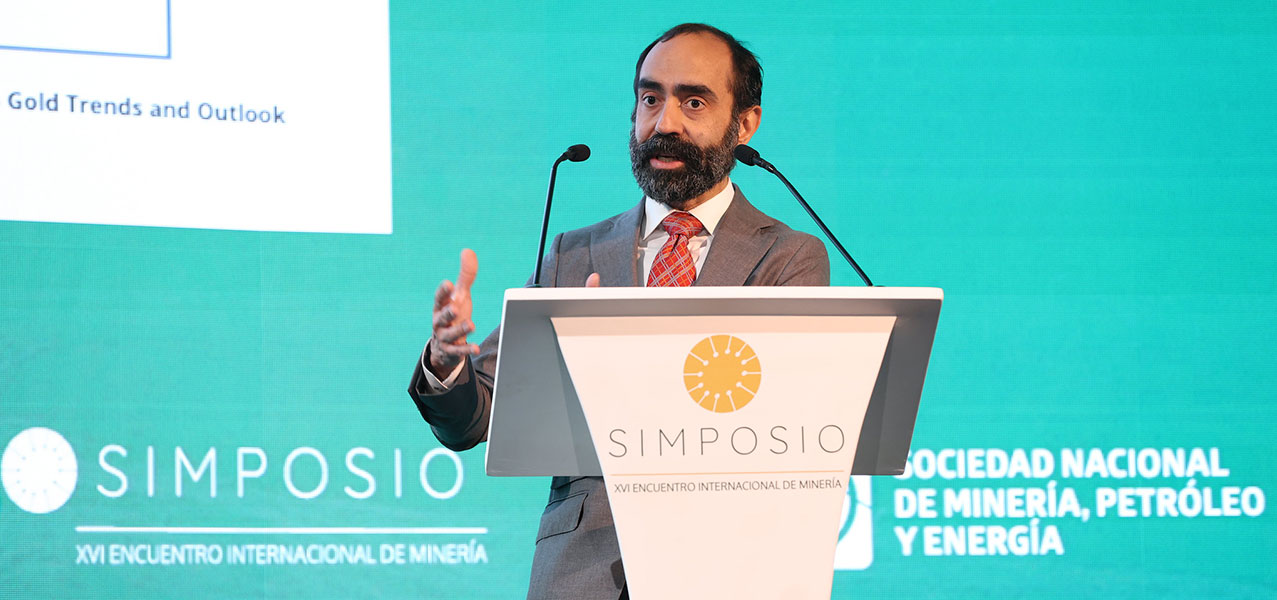
Lima, May 26, 2026. As part of the first day of the SIMPOSIO – XVI International Mining Meeting, Juan Carlos Artigas, regional CEO for the Americas and global head of research for the World Gold Council (WGC), participated in the session titled “Global Mining Executives: Strategy, Markets, and Outlook” with a presentation focused on gold and its role in today’s global economy.
During his speech at the event organized by the National Society of Mining, Petroleum, and Energy (SNMPE), the executive noted that nowadays, gold goes beyond its traditional role as a safe-haven asset and is emerging as a strategic resource in the digital and technology economy.
“We often think of gold as a safe-haven asset, rather than considering its role in investment. It is important to note that approximately 40 to 45% of gold demand is linked to investment, while another 35% is associated with direct consumption, whether through jewelry or technology. All the electronic devices we use contain gold components,” Artigas pointed out. He added that its application in sectors such as artificial intelligence further reinforces gold’s relevance in contemporary technological infrastructure.
The new status of gold as a “strategic mineral,” combined with geopolitical tensions and the fragmentation of globalization, is keeping the metal at historic price levels. Artigas noted that “the price of gold currently stands at approximately US$4,500 per ounce, having reached a high of over US$5,400 in previous months.”
He argued that economic expansion drives real demand for gold. “When there is more economic growth, there is more consumption and also more long-term savings; these two factors are positively linked to investment,” Artigas stated. Technological consumption, savings, interest rates, and currency volatility interact and create a scenario where gold maintains high and sustained prices.
He also noted that the leadership in global gold demand has shifted. “Most of the demand comes from emerging markets, including Asia, Latin America, and the Middle East,” Artigas said. China, India, and Southeast Asia are leading this shift, displacing traditional players.
The phenomenon is accentuated by the trend followed by central banks, which have doubled their net gold purchases in recent years. This strategy aims to diversify reserves and reduce exposure in a context of greater uncertainty and a search for solid assets.
In producing countries such as Peru, the economic impact of gold is disproportionate to the volume mined. Although copper accounts for a larger tonnage, the high price of gold multiplies the financial benefits for local economies. “Even though gold mining is smaller in volume, given its very high price, the economic impact is very significant,” the executive emphasized.
The price boom is also boosting artisanal and small-scale mining worldwide. “Of 100% of mineral production, approximately 20 to 25% is currently extracted through small-scale or artisanal mining, and that figure is growing,” Artigas noted, pointing out that this phenomenon poses challenges in terms of regulation, sustainability, and risks of illegality.
Photos available at the following link: https://flickr.com/photos/195630249@N08

