

XVI SIMPOSIO: Proposals to Expedite Permits and Consolidate the Exchange of Technical Information to Boost Mining Exploration in Peru
- At the panel “Opportunity and Challenge: Mining Exploration in Peru”, specialists agreed that the country must expedite permits and share geological information. to attract capital and investment.
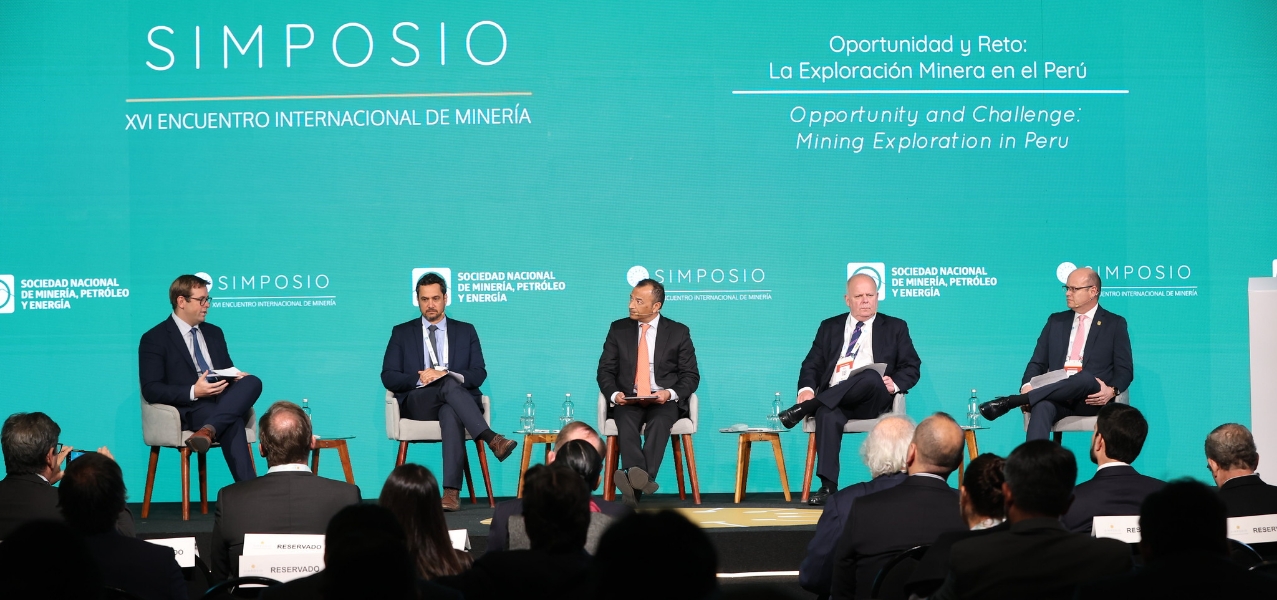
Lima, May 28, 2026. Peru needs to reduce the complexity of state permits and promote greater collaboration among mining companies to improve the quality of exploration, attract capital and accelerate the discovery of new projects, specialists agreed during the SIMPOSIO – XVI International Mining Meeting, organized by the National Society of Mining, Petroleum and Energy (SNMPE).
These ideas were presented during the panel “Opportunity and Challenge: Mineral Exploration in Peru”, led by Sebastián Benavides, Discovery Manager for the Andes Region at Anglo American. The panel gathered Joe Mazumdar, editor and analyst at Exploration. Insights; Jonas Mota-e-Silva, president of the SNMPE Exploration Committee and exploration manager at Rio Tinto; Juan Carlos Ortiz, president of the Peruvian Institute of Mining Engineers; and Michael Di Rienzo, president and CEO of Silver Institute.
Juan Carlos Ortiz stated that the main factors hindering the development of mining exploration in Peru are related to social issues and the complexity of the permitting process. He noted that trust with local communities must be established from the very beginning and cited the Tía María project as an example of a project progressing due to ongoing outreach efforts.
During the debate, the panelists highlighted the work of the Geological, Mining, and Metallurgical Institute of Peru (INGEMMET) in generating accessible, high-quality geological information. Mota-e-Silva indicated that Peru has a significant technical base; however, there is an opportunity to enhance exploration efficiency by sharing data generated by mining companies. Statistics reveal that 60% of operating mines have been owned by at least three different companies throughout their existence.
Mota-e-Silva argued that the country should move toward a system that allows for the sharing of private information after a confidentiality period, as is the case in other jurisdictions. “It makes no sense for a company to drill in the same place where another has already drilled and found nothing,” he stated. This practice would not only improve the industry’s efficiency but also reduce the frustration of communities that witness repeated drilling campaigns without concrete results.
Meanwhile, Joe Mazumdar indicated that exploration capital always evaluates the risk-reward ratio. While acknowledging that risks have increased, he maintained that Peru’s geological reward remains significant. “The risks have increased, but the reward is still there,” he stated. He added that the country must reduce friction and adopt a more systematic approach, allowing investors to primarily assume geological risk rather than additional risks related to permits, social licenses, or uncertainty.
For his part, Michael Di Rienzo warned that illegal mining represents a governance risk signal for capital markets. He explained that this problem affects not only Peru but also other regions such as Africa and that it requires coordinated responses, traceability, and international partnerships.
“Illegal mining is not considered just a legal problem; it is considered a sign of sovereign governance”, he stated. He added that around 20% of the gold that reaches the global market comes from artisanal mining, and that the problem arises when these activities use mercury, pollute rivers, and generate environmental and social consequences.
Finally, the panelists agreed that Peru has the geology, talent, mining culture, and public information necessary to remain a relevant jurisdiction. However, they emphasized that the country must expedite the permitting process, protect existing concessions, share geological data, and define a long-term mining policy that enables it to convert its potential into new, formal, and sustainable projects.
Photos are available at the following link: https://flickr.com/photos/195630249@N08

