



XVI SIMPOSIO: The Successful Transformation of The Mining Sector Requires Combining Technology and Long-Term Talent Management
- Companies are promoting comprehensive value propositions to attract and retain talent.
Lima, May 28, 2026 – Experts concurred during the SIMPOSIO–XVI International Mining Meeting, organized by the National Society of Mining, Petroleum and Energy (SNMPE), that talent management in the mining industry relies more on organizational quality, internal culture, and leadership than on technology.
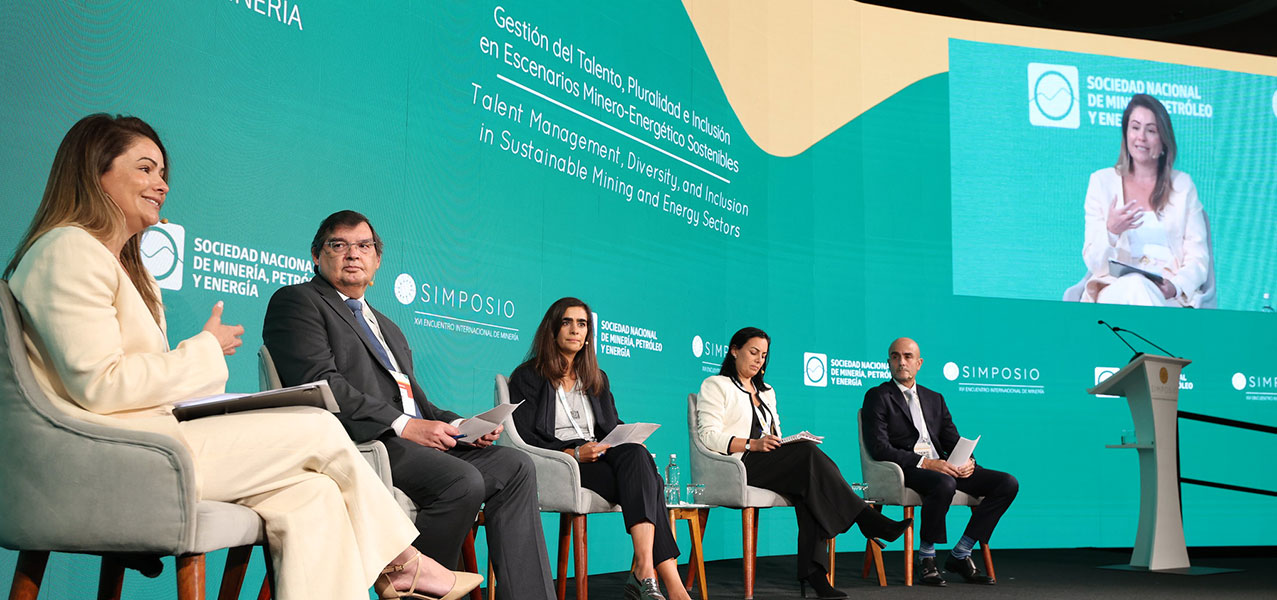
These ideas were presented during the panel “Talent Management, Diversity and Inclusion in Sustainable Mining and Energy Sectors”, led by Priscila Gomes, an international consultant, with the participation of Carlos Alarco, Regional President for Latin America at Bechtel; José Carlos Del Valle, CEO of Nexa Peru; Mariana Abugattas, Country Manager for Peru at Teck Resources; and Myriam Akhoun, CEO & Country Manager of ENGIE – Energía Peru.
During the panel discussion, participants highlighted the challenge of attracting new talent to the mining sector amid the energy transition, artificial intelligence, automation, and increasing global competition for technical, digital, and specialized professionals.
José Carlos Del Valle asserted that while technology is a crucial tool, it is insufficient for transforming the industry. “Technology alone will not take us where we want to go. What is pivotal is the combination of technological transformation with organizational transformation,” he stated. He further emphasized that the latter is the most complex aspect, as “it depends on people” and necessitates a sustained commitment to culture, leadership, and adaptation.
Del Valle stressed the need for the mining industry to broaden its talent pool, integrate new digital profiles, and reskill its workforce. He observed that technology will not only alter operational processes but also redefine the profiles of individuals capable of performing these tasks, thereby creating opportunities for engineers, data scientists, programmers, and professionals from diverse disciplines.
Myriam Akhoun noted that younger generations prioritize factors beyond traditional considerations when selecting their workplaces. “New generations seek purpose, development opportunities, diversity, and inclusion. These three elements significantly influence the attraction and retention of talent,” she stated.
The CEO and Country Manager of ENGIE – Energía Perú explained that, in the energy sector, purpose is intrinsically linked to the energy transition and the diversification of the energy mix towards cleaner sources.
Mariana Abugattas emphasized that attracting and retaining talent is significantly influenced by the type of culture that leaders foster within the workplace. “It’s about leadership, about assessing the characteristics of our leaders and the cultures they cultivate,” she stated. She highlighted the importance of companies creating “respectful, safe, and inclusive” environments for all employees, placing “the individual at the center of all initiatives.”
Abugattas also noted that newer generations prioritize more agile organizations. In this context, she suggested that it is essential to provide employees with greater autonomy, adapt to new models of in-person work, and promote professional development through mentorship, trust, and recognition.
Carlos Alarco emphasized that talent development cannot fall solely on companies. “Change shouldn’t happen only within the four walls of our companies; it’s an ecosystem change,” he stated. He pointed out that talent comes from universities and even schools, so alliances between industry and academia are needed to accelerate the training of the professionals the sector requires.
Alarco proposed working with universities, promoting teacher internships in mining operations, and bringing mining closer to students from an early age, especially women interested in engineering and technology careers.
He also emphasized the need for the mining industry to enhance its communication of opportunities and achievements to better attract young talent. “There is a wealth of positive news to share, but we are not conveying it effectively,” he stated. He elaborated that the mining sector presents a multitude of job opportunities for well-educated young individuals, yet this encouraging narrative is not being communicated with sufficient vigor.
Furthermore, the panelists concurred that the advancement of technology must be complemented by training, the development of digital skills, and the enhancement of soft skills such as adaptability, communication, collaboration, and leadership. They concluded that transforming the mining workforce necessitates the preparation of individuals who are adept at utilizing technology, embracing change, and fostering more humane, diverse, and inclusive cultures.
Photos are available at the following link: https://flickr.com/photos/195630249@N08

