

XVI SIMPOSIO: Joaquín Proenza States That “Without Mining There Is No Energy or Digital Transition”
- A professor at the University of Barcelona argued that sustainability must be a critical strategy for all mining operations, in a context of growing global demand for minerals critical to the energy transition by 2050.
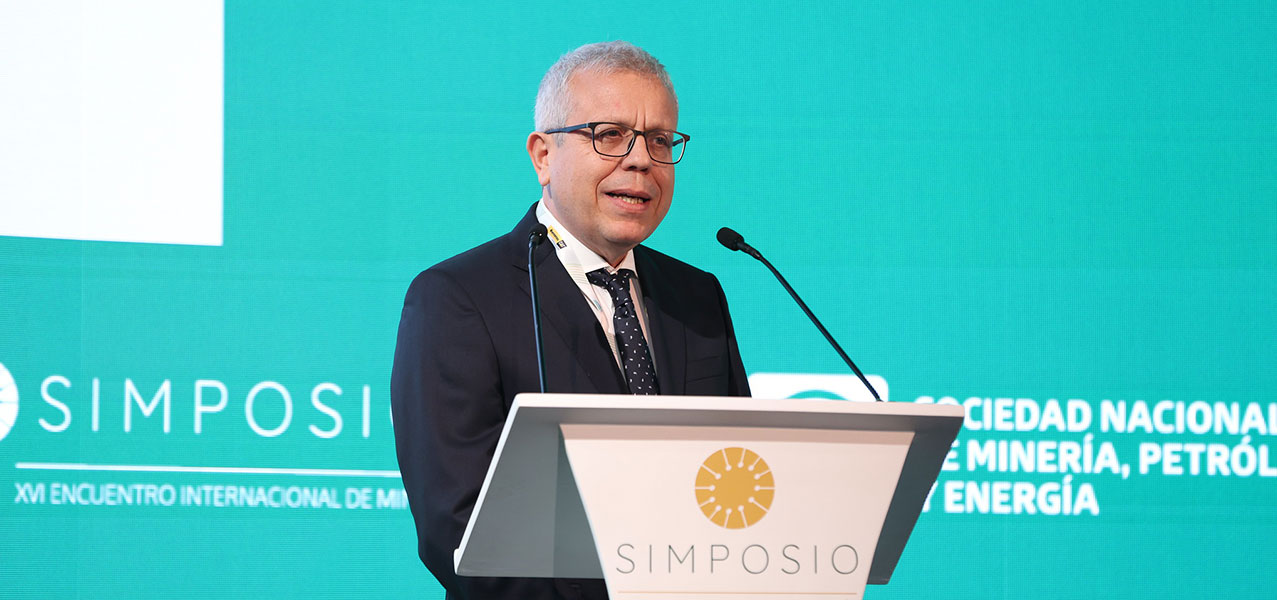
Lima, May 27, 2026. Joaquín Proenza, a geologist and professor at the University of Barcelona, emphasized that advancing energy and digital transitions requires a mining industry capable of discovering, extracting, and processing critical minerals on an unprecedented scale.
During his presentation “Reflections on critical minerals and mining for a sustainable energy transition”, presented at the SIMPOSIO– XVI International Mining Meeting, organized by the National Society of Mining, Petroleum and Energy (SNMPE), Proenza argued that mining plays a central role in the new global scenario, marked by the growth of renewable energies, digitalization, artificial intelligence and competition for secure supply chains.
“Without mining, there is no energy and digital transition, but there will also be no mining without sustainability,” he stated. In this context, he emphasized that sustainability must be understood as a critical and multidimensional strategy for all mining operations—not merely as an environmental requirement but as an essential condition for the continuity and legitimacy of the industry.
Proenza explained that the accelerated deployment of clean technologies necessary for the energy transition will result in a substantial increase in mineral demand. He noted that by 2050, the global energy mix will be increasingly dominated by renewable sources, particularly solar and wind power, which require significantly more materials than fossil fuel-based technologies. “The principal challenge for the mining industry is to discover, extract, and process mineral resources on an unprecedented scale,” he stated. He further emphasized that the demand for critical minerals could potentially quadruple in the coming decades.
In this context, he contended that energy security will increasingly hinge on the security of the supply chain for critical minerals. Consequently, he asserted that countries must establish clear mining policies to ensure access to these resources in a landscape where critical minerals have become pivotal to strategic autonomy and national security.
The expert warned that the global concentration of critical mineral processing capacity has major geopolitical implications. In particular, he noted that China is working toward a leading position in this key stage of the value chain, which has led to increasing talk of “geopolitical mining.” “Critical and non-critical mineral resources are already defining the power map of the 21st century,” he asserted.
Given this scenario, Proenza highlighted the enormous potential of Latin America and the Caribbean to diversify the global supply of critical minerals. He indicated that the region ranks among the top producers of copper, lithium, niobium, iron, aluminum, silver, lead, and zinc, and also has potential for nickel, cobalt, platinum group metals, and other strategic resources.
However, he cautioned that this opportunity must be capitalized on throughout the entire value chain. To achieve this, he deemed it necessary to promote strategic industrial policies, develop technological capabilities, incentivize processing, refining, and recycling projects, and integrate the region into global supply chains. “Without industrialization, a significant portion of the value of raw mineral materials is lost,” he emphasized.
Proenza also highlighted the importance of diversifying primary sources of critical minerals. While conventional deposits will remain the main source of supply, he called for greater attention to be paid to unconventional mineral deposits, tailings ponds, and mineral byproducts.
In this context, he argued that mining must adopt a concept of “total value,” ensuring that no mineral or metal with economic potential is wasted in a tailings pond. He cited the San Vicente Mine in the Chanchamayo region of Junín as an example, noting its enormous potential to recover strategic elements such as gallium, germanium, and cobalt from sources that have not traditionally been considered central to the mining business.
Finally, Proenza pointed out that transforming mining liabilities into resources represents an opportunity to reduce environmental impacts and, at the same time, expand the availability of critical minerals. “No metal, no mineral that has economic value, should end up in a tailings pond,” he concluded.
Photos are available at the following link: https://flickr.com/photos/195630249@N08

