

XVI SIMPOSIO: Latin America Has the Opportunity to Become a Key Supplier of Minerals Critical for the Energy Transition, according to Paul Mitchell
- Paul Mitchell, Global Mining & Metals Leader at EY Global, argued that the region must act in an integrated manner, attract capital, share infrastructure, and build value chains to take advantage of its potential in copper, lithium, nickel, and other strategic minerals.
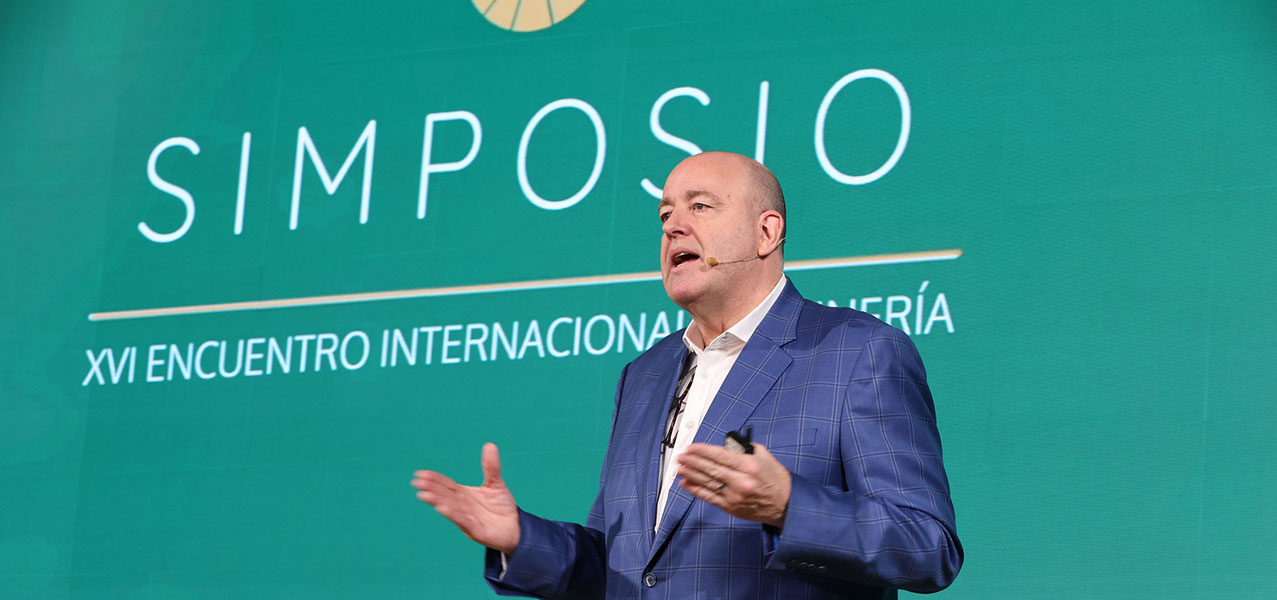
Lima, May 28, 2026. Latin America has the opportunity to become a key supplier of critical minerals for the energy transition, energy security, electrification, and the digital revolution, said Paul Mitchell, Global Mining & Metals Leader of EY Global, during his conference “Maximizing the Critical Minerals Opportunity for Latin America”.
In his presentation at the SIMPOSIO– XVI International Mining Meeting, organized by the National Society of Mining, Petroleum and Energy (SNMPE), Mitchell noted that the region must prepare to compete for capital in an increasingly demanding scenario, in which energy security, defense, urban growth, and digitalization will also require greater investment funds.
“Latin America is highly relevant to the global energy transition,” he stated. Along those lines, he maintained that the region has a decisive role to play due to its potential in copper, lithium, nickel, iron, and other essential resources for moving, storing, and using energy in the coming decades.
Mitchell explained that critical minerals should not be viewed solely as resources linked to the energy transition, but rather as essential elements necessary to sustain and enhance society’s way of life. He emphasized that copper will be crucial for electrification, lithium for energy storage, and iron for the infrastructure needed to support urban and technological growth.
Mitchell warned that the conflict in the Middle East has accelerated a shift in the global conversation, with the world increasingly focusing on energy security rather than energy transition. He noted, however, that for many countries, achieving energy security will require investments in renewable energy, which will once again increase demand for copper, lithium, nickel, and other critical minerals. He added that countries lacking sufficient oil or gas reserves will need to bolster their renewable energy systems, making the availability of critical minerals even more essential.
In this context, Mitchell stressed that Latin America must create attractive conditions for capital investment. He indicated that mining investments will become more competitive and costly in the coming years, so countries must provide regulatory certainty, tax stability, predictable permitting processes, access to talent, and adequate infrastructure.
“We are not asking for it to be easier; we are asking for it to be safe,” he said, referring to the need for investors to have clarity about the conditions under which they will commit capital for several decades.
Mitchell also highlighted that developing new projects will require different financing models, partnerships, joint ventures, and the participation of new capital providers. He noted that future mines will demand large-scale investments, making it necessary to share risks and improve discipline in project execution.
The EY Global representative argued that the region should not approach this opportunity in isolation, country by country or company by company. On the contrary, he suggested that Peru, Chile, Argentina, Brazil, and Mexico, among other countries, must work together to build a more competitive regional strategy.
“It’s not just about how we optimize Peru. It’s about how we optimize Peru, Chile, Argentina, Brazil—all of us together,” he stated. In that regard, he indicated that the region must ask itself where it is advantageous to process minerals, where to add value, where more competitive energy is available, what infrastructure can be shared, and how to distribute the benefits among the countries involved.
Finally, he emphasized that Latin America must move towards regional value chains, with increased processing and refining, greater innovation, shared infrastructure, and collaboration with universities, suppliers, and governments. “We have to ensure that not only the mineral comes from Latin America, but that the entire value chain for that mineral also originates in Latin America,” he concluded.
Photos are available at the following link: https://flickr.com/photos/195630249@N08

